

Oooohhhhh, the thrill of playing the lottery or playing the slot machine…. What about playing poker or blackjack…… Ooooo, what about scratch-offs or horses… An NFL, NBA, or MLB game, and possibly a boxing match? Regardless of which one you choose, they are all events with probabilities that, if you bet enough, could make you rich. Not filthy rich, but they can offer a nice payout for taking a chance on it. Not everyone can be Rainman or a natural mathematician. We are not walking Texas Instruments scientific calculators. No, we are talking about gambling. See, the world is filled with average folks who hope that somewhere in the Universe, it is written in the stars that they will win the lottery for millions or trillions of dollars. To become super rich and never have to work for anyone ever again…..
At a glance, gambling is ancient; the smartphone version is not. Today, odds, deposits, live statistics, parlays, and payouts can fit inside one app. That convenience has expanded legal markets and tax revenue while narrowing the gap between impulse and wager. Some know when to stop, and some struggle. For those who do the gambling and those who take the money and bets over time, it has opened doors for those who work in the industry and those who provide the means for gambling to take place. They say it’s nothing like the thrill of winning. Especially when money is involved. Across history, gambling often followed the same cycle: people found a new way to wager, authorities tried to prohibit or control it, businesses organized it, and governments eventually discovered that regulation and taxation could be more practical than pretending it did not exist.
In this blog, we will learn about the history of gambling and the vices associated with it. We will also discuss where you can go to get help, and two sportsbook operators describe the excitement, money, technology, and weak safeguards behind modern betting. Their experiences help explain both the industry’s appeal and its growing public-health challenge. So, with that being said, go call your cousin Brittany and ask her for her babysitter’s number. Then go pack a bag… or two for the weekend, and don’t forget to call grandma and tell her to be ready. Last time she rushed, packed, and forgot her teeth!! Biloxi here we coooommmmmeeeee!!!!!!!!!!!!!!!!!
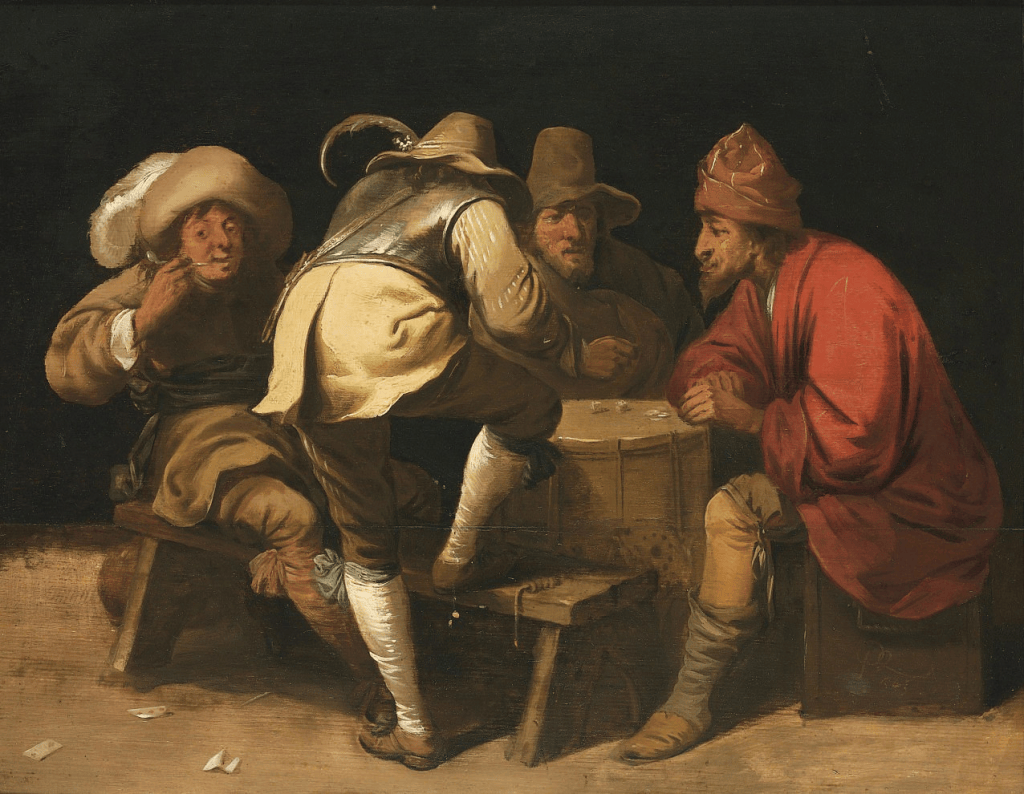
So where did gambling actually begin?
There is no single inventor, birthplace, or opening day for gambling. It appears to have developed independently wherever people created games with uncertain results and then attached something valuable to the outcome. Archaeologists have found ancient dice, lots, and game pieces across the world. Some began as tools for divination or social games before people started wagering possessions, food, animals, labor, or money on the result. Recent archaeological research has pushed the story even further back. Evidence from Indigenous sites in western North America suggests that people were making two-sided dice and playing structured games of chance near the end of the last Ice Age.
In the ancient Near East, Egypt, India and China, dice and lottery-like practices also appeared thousands of years ago. Ancient Greeks and Romans wagered on dice, athletic contests, animal fights and chariot races—even when authorities tried to restrict the practice. In other words, gambling did not begin because somebody built a casino. Casinos came much later. Gambling began with a far simpler human temptation: the possibility that one uncertain outcome could suddenly change what a person owned.
From informal wagers to organized business
Over time, informal wagers became organized lotteries, betting shops, racetracks, casinos, and regulated sportsbooks. The modern casino developed as a place where games could be concentrated, supervised, and taxed. Bookmakers turned sports knowledge into posted odds, point spreads, and organized markets. Radio, telephones, television, and electronic score feeds then sped up the exchange of betting information.
Lotteries gave rulers and governments a way to raise money while offering the public a small chance at a large prize. Horse racing helped formalize bookmaking because bettors needed published odds, clear rules, and someone willing to accept many wagers on the same event. Playing cards spread across Europe and created new games in which skill, chance, and money could mix at the same table.
The first public casino
The modern casino is generally traced to Venice. Gambling was already common in private rooms and on the streets, especially during Carnival. Rather than pretend it could make wagering disappear, the Venetian government chose to contain and supervise it. In 1638, it authorized Il Ridotto, a government-controlled gambling house in the Palazzo Dandolo near the church of San Moisè. Il Ridotto was technically public, but its formal dress rules and high stakes made it far more accessible to wealthy nobles than ordinary residents. It offered card and lottery-style games while giving authorities a controlled location for gambling. That formula—concentrate the games, regulate the operators, and collect revenue—became the foundation of the modern casino industry.

How America and Las Vegas entered the story
Gambling arrived in North America through many traditions, including Indigenous games, European lotteries, card games, horse racing, and informal frontier wagering. Public opinion moved back and forth between tolerance and prohibition. States frequently outlawed one form of gambling while allowing, taxing, or quietly overlooking another. Nevada became the defining American example. The state first legalized and regulated commercial gambling in 1869, later prohibited it during the Progressive Era, and restored ‘wide-open’ gambling on March 19, 1931.
The law did not invent Nevada gambling; it brought a long-standing activity back into a legal licensing system. Las Vegas then transformed gambling into a complete tourist experience. Casinos were joined by hotels, restaurants, nightclubs, celebrity shows, and elaborate architecture. By the late twentieth century, the casino was no longer merely a room with games. It was the center of an entertainment resort designed to keep visitors on the property—and spending money.
The internet takes the bet worldwide.
The internet produced the decisive break. Academic and government histories place the first real-money online casino wagers in the mid-1990s. At first, online betting required a desktop computer and comparatively slow payment systems. Smartphones erased those limits. A bettor no longer had to travel to a casino, find a bookmaker, or even wait for the next game. A Michigan Senate Fiscal Agency review identifies 1996 as the year the first recorded online casino accepted a wager from Antigua. It counted only 15 online casino sites by the end of that year, but approximately 650 by the end of 1999 and 1,800 by the end of 2002. The casino floor had become a website, and the website soon became an app.
From a destination to a device
Modern betting apps combine several functions that once belonged to separate places and people: an odds board, an account window, a cashier, a statistics service, a marketing department, and an in-app live broadcast companion. A customer can compare a moneyline, build a same-game parlay, place an in-game wager, and receive a result without leaving the couch. The U.S. legal landscape also shifted. In 2018, the Supreme Court’s decision in Murphy v. NCAA invalidated federal provisions that prohibited states from authorizing sports betting. The ruling did not legalize sports betting everywhere at once; it left it to the states to decide.
The result has been rapid but uneven expansion, with different rules, tax rates, permitted products, and age-verification requirements. The scale is striking. According to the American Gaming Association, regulated U.S. sportsbooks accepted $166.94 billion in wagers during 2025 and generated $16.96 billion in revenue. Internet casino gaming generated another $10.74 billion. These are industry figures, so they should be read with that perspective in mind, but they clearly show that app-based wagering is no longer a niche activity.
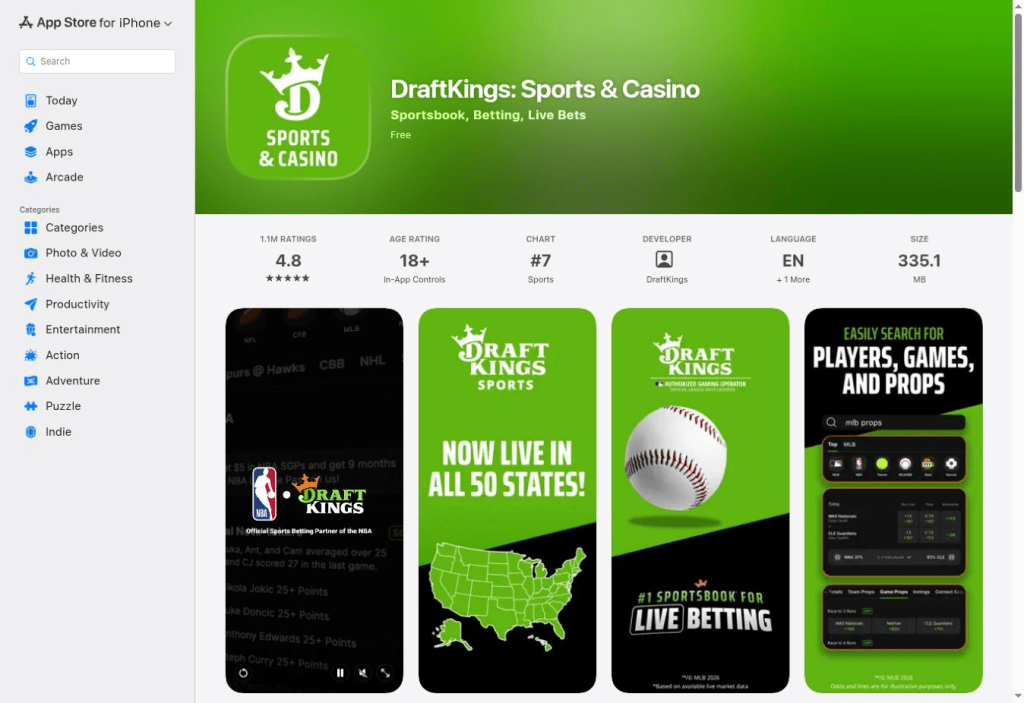
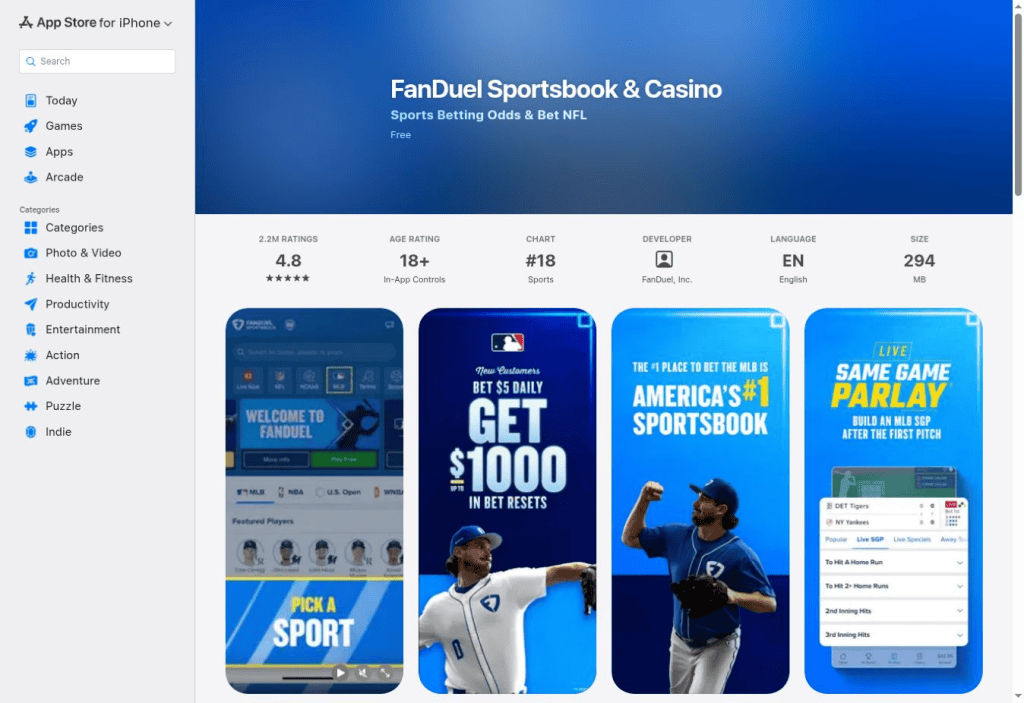
The sportsbook in your pocket
DraftKings, FanDuel, BetMGM, Caesars Sportsbook and William Hill are among the most recognizable names in mobile wagering. Their interfaces place live odds, player propositions, same-game parlays, promotions and account funding within a few taps. The screenshots below show how betting products are packaged as bright, fast-moving entertainment.

Casino websites sell a complete entertainment experience—not only gambling. This Bellagio homepage promoted its Cirque du Soleil production at the time of capture. Screenshot: Bellagio/MGM Resorts website. Shown for educational discussion.
What two operators say happens behind the screen
Two anonymous sportsbook operators completed questionnaires for this blog. One reported 15 years in the industry and described working through a licensed sportsbook in Las Vegas. The other reported about 10 years in the industry and described operating independently. Their answers are personal accounts; they are not a representative survey, legal determination, or endorsement of any practice.
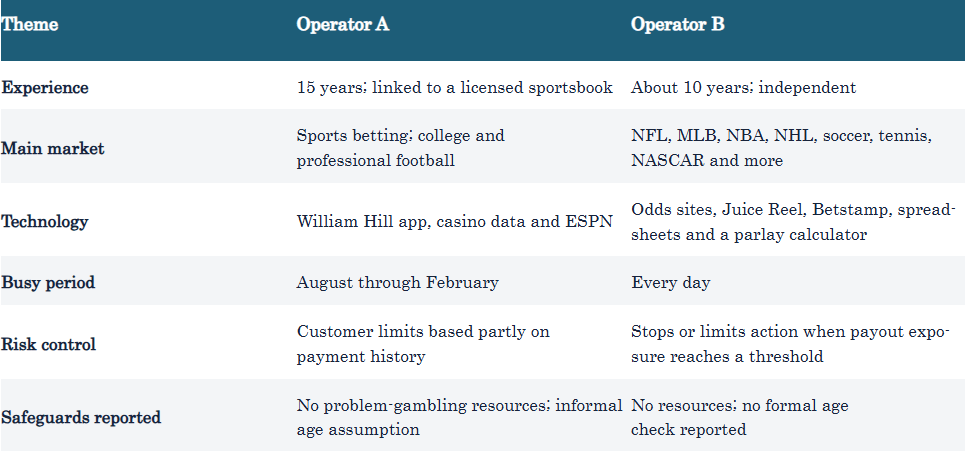
Source: Two questionnaires supplied for this blog. Responses were lightly edited for spelling and clarity.
Technology is the strongest common thread. One operator said bets and payouts are tracked through a casino app; the other named multiple odds and bet-tracking tools. That reflects a wider transformation: information that once traveled on printed pages and over telephone lines now moves instantly through software.
The questionnaires also expose a serious weakness. Both respondents said they do not provide responsible-gambling resources, and neither described a reliable age-verification process. Those practices should not be treated as acceptable simply because they occur. Licensed operators must follow the laws and regulatory requirements of the jurisdiction in which they operate; customers should use only legal, regulated platforms available where they are physically located.


When gambling stops being entertainment, the consequences often show up first in household finances and relationships. Photo: Mikhail Nilov/Pexels.
Why betting can become addictive
Most people who gamble do not develop a gambling disorder. But for some, gambling becomes a persistent behavioral addiction that continues despite financial, relationship, work, or health consequences. The American Psychiatric Association identifies gambling disorder as repeated, ongoing wagering that causes significant problems. The World Health Organization likewise treats gambling harm as a public-health issue—not a failure of character.
Apps can intensify risk by making gambling private, fast, and continuously available. Research on smartphone betting links its situational features to more continuous play, faster wagering, and gambling-related debt. Live betting creates repeated opportunities within a single game. Push notifications and promotions can reactivate attention. Digital deposits can make money feel less tangible than cash, while near misses and occasional wins can encourage another attempt.
Warning signs worth taking seriously
Warning signs of a possible gambling problem include:
- Needing to gamble with increasing amounts of money to experience the same excitement.
- Feeling restless, anxious, or irritable when trying to reduce or stop gambling.
- Repeatedly trying—and failing—to control or stop gambling.
- Constantly thinking about bets, odds, previous losses, or ways to obtain gambling money.
- Chasing losses by returning to win back money that has already been lost.
- Hiding the amount of time or money spent gambling.
- Lying to family members or friends about gambling activity.
- Jeopardizing relationships, employment, education, housing, or financial security.
- Borrowing money, missing bills, or relying on other people to cover gambling losses.
- Gambling when feeling depressed, anxious, angry, lonely, or desperate.
- Believing that one large win will solve all financial problems.
Getting help: practical first steps.
Recovery from gambling addiction is possible, and a person does not need to wait until a crisis occurs before seeking help.
Evidence-based care may include cognitive behavioral therapy, motivational approaches, peer support, financial counseling, and treatment for co-occurring conditions such as depression, anxiety, or substance misuse.
Someone concerned about their gambling can begin with the following steps:
- Tell one trusted person what is happening. Secrecy gives the problem room to grow.
- Use self-exclusion and account-closing options offered by state regulators and licensed gambling platforms.
- Set strict deposit, wager, and time limits. Do not increase those limits after losing.
- Ask a bank or credit-card company whether it offers a feature that blocks gambling transactions.
- Remove gambling applications and saved payment methods from phones and computers.
- Avoid borrowing money or using money intended for rent, food, utilities, medicine, or other necessities.
- Ask a licensed mental-health or addiction professional about screening and treatment for gambling disorder.
- Use the National Council on Problem Gambling’s help-and-treatment website to locate appropriate support and local resources.
- Consider peer support through Gamblers Anonymous, including in-person or virtual meetings.
If gambling losses lead to thoughts of self-harm or immediate danger, contact local emergency services or go to the nearest emergency department immediately.

How gambling is likely to evolve next
The next stage will probably be less about creating a brand-new form of gambling and more about making every part of the experience faster, more personalized, and more tightly connected to entertainment.
More live and micro-betting. Markets may expand from a game’s final result to the next play, pitch, point, possession, or other short event. This creates more inventory for operators—and more rapid decision cycles for bettors.
Artificial intelligence on both sides. Bettors will use AI to compare odds, analyze injuries, and build models. Operators will use it for pricing, personalization, fraud detection, marketing, and risk management. As one interviewee warned, AI can still be wrong when data are stale or incomplete.
Blended media and betting. Streaming, statistics, social communities, and wagering may increasingly occupy the same screen. That could make betting feel like a normal part of watching sports rather than a separate financial decision.
Stronger digital safeguards. The same data used to personalize promotions can identify risky patterns. Effective systems could trigger cooling-off periods, affordability reviews, clearer loss summaries, marketing limits, or human outreach.
Continued regulatory conflict. States will continue debating legalization, advertising, college sports markets, data privacy, taxes, age checks, and consumer protection. Prediction markets and other event contracts may further blur regulatory boundaries.
The real question is not whether gambling will grow.
The two operators interviewed for this blog disagree about whether regulation should increase. Yet both gave nearly identical warnings to people considering the business: stay away. That contradiction is revealing. Gambling can be exciting, technologically sophisticated, and profitable, while still producing unpaid debts, conflict, and harm. The future of betting is almost certainly digital. The public choice is whether its safeguards will advance as quickly as its products. A responsible market should verify age, explain odds plainly, display net losses honestly, make limits easy to set, restrict predatory promotions, identify risky play early, and connect people with help before a crisis. Gambling began as a social encounter with chance. It evolved into an industry, then a regulated venue, and now an app that can follow a person everywhere. The technology will keep changing. The need for informed choice, enforceable rules, and human care will not.
Sources and further reading
Interview material: Two anonymous sportsbook-operator questionnaires supplied by the requester. All other factual claims are supported by the sources below.
1. Madden — Probability in the Pleistocene: Native American Dice, Games of Chance, and Gambling
2. Images of Venice — Casinos and Ridotti
3. University of Nevada, Las Vegas — Dates That Changed the Gaming World
4. Nevada Legislature — Policy and Program Report: Gaming
5. World Health Organization — Gambling fact sheet
6. American Psychiatric Association — What Is Gambling Disorder?
7. U.S. Supreme Court — Murphy v. NCAA (2018)
8. American Gaming Association — 2025 commercial gaming revenue
9. American Gaming Association — State of Play map
10. National Institute on Drug Abuse — Gambling Disorder in the Age of Mobile Sports Betting
11. Hing et al. — Situational features of smartphone betting and gambling harm
12. Valenciano-Mendoza et al. — Clinical correlates of sports betting: systematic review
13. Hong et al. — The Cultural Evolution of Games of Chance
14. Williams & Wood — Internet Gambling: A Comprehensive Review
15. Michigan Senate Fiscal Agency — History and Regulation of Online Gaming
16. National Council on Problem Gambling — Help and Treatment
17. Gamblers Anonymous — U.S. meetings and information
Editorial note: The legal status of sports betting and online casino gaming changes by jurisdiction. This blog provides general information, not legal, medical, or financial advice.
 Realizations with Tiffany K. Charles