
Christmas is simultaneously (1) a Christian liturgical feast centered on the Nativity of Jesus and (2) a cultural “winter holiday” that many non-Christians celebrate in some form. That double identity is not an accident—it is the product of roughly 1,700 years of theological debate, political change, folk practice, migration, commerce, and media.
What follows is a historically grounded account of the origins of Christmas, the pre-Christian customs with which it overlapped (and sometimes replaced), how its meanings have shifted over time, and what we can responsibly predict about its future evolution.
1) Before “Christmas”: Midwinter Was Already a Big Deal
Long before Christianity became a dominant religion in Europe, midwinter carried an obvious psychological weight: cold, darkness, food scarcity, and the hope that the sun’s “return” (longer days) meant survival. Many cultures marked this season with light, greenery, feasting, and social relaxation.
Rome’s Saturnalia and the midwinter “party season.”
In the Roman world, Saturnalia was among the most popular public festivals, associated with feasting, gift-giving, and a loosening of social norms. Encyclopedia Britannica+1
This matters because later Christmas customs—banquets, merrymaking, and indoor greenery—resemble one another. Similar, however, does not mean “copied wholesale.” In many cases, Christians and pagans simply lived in the same cities and used the same seasonal “language” of celebration.
Sol Invictus and the “birthday of the unconquered sun” question
A later Roman solar cult, Sol Invictus, is often mentioned in popular explanations of Christmas. The key historical point is that the relationship between the December 25 solar festival and Christmas remains debated, and the evidence does not support a straightforward “the Church stole a pagan holiday” narrative.
What we can say confidently is this:
- The earliest surviving reference to December 25 as Jesus’ birthday appears in the Chronography of 354 (also called the Philocalian Calendar tradition), which includes the entry “Christ was born in Bethlehem of Judea.” National Geographic+1
- Scholars debate whether Christians chose December 25 to compete with or reinterpret a solar festival, or whether some solar observances crystallized in response to a Christian feast already gaining traction. Biblical Archaeology Society+1
In other words: midwinter already mattered, and multiple religious communities attached meaning to it—sometimes in parallel, sometimes in rivalry.

2) The Early Church: Jesus’ Birth Was Not Originally a Major Annual Feast
A typical modern assumption is that Christians have “always” celebrated Christmas. Historically, that is not correct.
- The New Testament does not give a date for Jesus’ birth.
- Early Christian focus was more on Easter/Pascha and the commemoration of martyrs than on birthdays.
- By late antiquity, various Christian regions commemorated Christ’s “manifestation” in different ways, with January 6 (Epiphany) particularly significant in the East before December 25 became widespread in the West. Catholic News Agency+1
So why December 25?
The most responsible historical answer is that we do not have a single, universally agreed-upon “why.” We have two primary explanations in scholarship, and they are not mutually exclusive:
- “Calculation” theory (internal Christian logic): Some Christians reasoned that Jesus was conceived on the same calendar date as his crucifixion; dating the crucifixion to March 25 (in some traditions) yields a birth nine months later on December 25. This line of reasoning is discussed in scholarly and semi-scholarly treatments of the evidence. Biblical Archaeology Society+1
- “Competition/assimilation” theory (social-political logic): As Christianity grew in the Roman Empire, aligning a major Christian feast with an already festive season may have made pastoral and political sense, helping redirect public celebration toward a Christian meaning.
The best summary is that December 25 emerges clearly in the 4th century, and the motivations likely combined theology, calendar symbolism, and cultural opportunity. Biblical Archaeology Society+1

3) “Pagan Customs Replaced”: What That Really Means (and What It Doesn’t)
When people say Christmas “replaced pagan customs,” they often imagine a one-time swap: Church leaders pick a pagan ritual and relabel it Christian. History is usually messier.
A more accurate model is layering and reinterpretation:
- Some seasonal practices predate Christianity by a long time (evergreen decorations, fires, feasting).
- Christian communities adopted, tolerated, or criticized local customs depending on time and place.
- Over centuries, practices became “Christmas traditions” even when their origins were mixed or unclear.
Below are the most-discussed examples, with careful attention to what we can and cannot claim.
A) Light, fire, and greenery: from winter survival symbolism to Christian metaphor
Greenery indoors (holly, ivy, evergreen branches) is well attested as a midwinter custom, including in Roman contexts; it later appears as a Christmas decoration across Europe. National Geographic+1
Christian symbolism easily mapped onto it: evergreen as “life,” candles as “light in darkness,” etc.—themes that also fit Christian theological language.
The Yule log is a good illustration of “evolution” rather than simple replacement: the custom is well attested in later European folklore and early modern practice, then becomes “Christmas” in some places and “Yule” in others, and eventually survives as both a decorative concept and even a dessert form (bûche de Noël). A deeper pre-Christian lineage is often suggested but cannot be demonstrated in a straight line for every region. Wikipedia
B) The Christmas tree: a relatively recent “classic.”
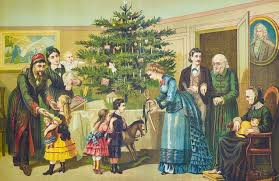
Decorated Christmas trees are not an ancient Christian practice. Most historians trace its popularization to Germany, followed by its spread to Britain and beyond in the 19th century, including through royal and print influence. National Geographic+1
This is an important corrective: some of what people call “pagan Christmas” is, in fact, modern Christmas—a product of early modern and Victorian culture.
C) Gift-giving: from multiple sources to a child-centered ritual
Gift-giving at Christmas has several streams feeding into it:
- Roman seasonal gift customs (including during the Saturnalia period). National Geographic+1
- Christian narratives, such as the Magi’s gifts (a theological anchor, though not a direct origin of household presents).
- The cult of Saint Nicholas, whose feast (December 6) carried gift traditions that later blended into Christmas gifting in various countries and, in the U.S., into Santa Claus. Encyclopedia Britannica+1
Over time, gift-giving shifted heavily toward children—especially in the 19th century, as middle-class domestic ideals and mass consumer goods expanded.
D) Mistletoe: often called “pagan,” but the modern custom is newer and traceable
Mistletoe is frequently linked (in pop culture) to ancient mythology, but the kissing custom is more securely documented in 18th-century England, and then spreads and gets romanticized. Smithsonian Magazine
That is a pattern you see repeatedly: a plant or symbol may have ancient associations, but the specific “Christmas behavior” attached to it can be surprisingly modern.
4) Medieval Christmas: A Church Feast and a Folk Carnival (Sometimes in Tension)
By the Middle Ages, Christmas had developed into a liturgical season (not just a day), intertwined with local folk practices such as processions, singing, plays, feasts, and “misrule” traditions in some regions.
- The idea of Christmastide (a broader festive season) is associated with the consolidation of feast observances preceding Epiphany. Christian History Institute+1
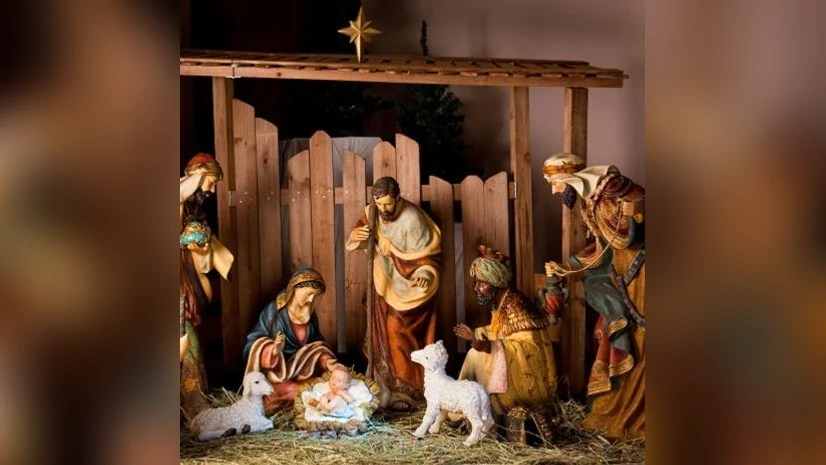
- Nativity scenes become prominent in the popular imagination through later medieval devotion; Saint Francis of Assisi is widely credited with staging a live Nativity at Greccio in 1223, helping make the Nativity vivid and “embodied” for ordinary worshippers. Catholic News Agency+1
- “Carol” referred initially to song forms that could include dance and procession; Christmas caroling, as we recognize it, emerged from a long medieval and early modern development. Encyclopedia Britannica
This period matters because it shows Christmas as both:
- A structured church feast, and
- A socially permissive holiday season—sometimes rowdy, sometimes contested.
That tension sets the stage for what happens next.
5) Reformation and Backlash: When Christmas Was Contested (and Even Banned)
From the 16th to 17th centuries, some Protestant reform movements criticized Christmas for lacking an explicit biblical mandate and for encouraging disorder or “popish” ritualism.
Two well-documented examples:
England (mid-17th century)
During the Commonwealth and Interregnum, authorities suppressed or restricted Christmas festivities; later Restoration politics reversed much of this. The popular memory often simplifies this as “Cromwell banned Christmas,” but the historical reality is more institutional and complex. Cromwell Museum+1
Colonial New England (1659–1681)
The Massachusetts Bay Colony enacted a law penalizing the public “keeping” of Christmas (with a five-shilling fine), reflecting Puritan priorities and social control. Massachusetts Government+1
These episodes are crucial for accuracy because they demonstrate that Christmas has not always been universally embraced, even within Christianity. Its modern dominance is, in part, a later cultural construction.
6) The 19th Century Reinvention: How “Modern Christmas” Was Built
If you want the single most significant transformation of Christmas into what many people recognize today—family-centered, sentimental, child-focused, commercial—the 19th century is it.
Dickens and the moral imagination of Christmas
Charles Dickens did not “invent” Christmas, but his work helped push a powerful cultural narrative: Christmas as a season of charity, family warmth, and social responsibility. USC Dornsife
Cards and the technology of connection
The first commercial Christmas cards emerged in Victorian Britain; Henry Cole and John Callcott Horsley’s 1843 card is extensively documented in museum collections. Victoria and Albert Museum+1
The American Santa: literature → illustration → advertising
Santa Claus becomes a dominant Christmas figure in the United States through a pipeline of culture:
- The poem “A Visit from St. Nicholas” (published in 1823) strongly influenced the image of the Christmas Eve gift-bringer in America. Home+1
- Illustrators such as Thomas Nast help standardize Santa’s appearance and narrative elements (the North Pole, workshop themes) through mass-circulation print culture. Smithsonian Magazine+1
- In the 1930s, Coca-Cola commissioned Haddon Sundblom, whose Santa paintings reinforce a warm, approachable “modern” Santa. Importantly, Coca-Cola did not invent Santa, but it helped popularize a specific visual version. National Museum of American History+1
Christmas becomes embedded in state and labor calendars.
In the U.S., Christmas became a federal holiday for certain federal employees in 1870 (initially limited to those in Washington, D.C., alongside several other holidays). Congress.gov
This bureaucratic recognition matters: holidays become “real” not only through belief, but through pay schedules, school calendars, and commercial planning.

7) The 20th–21st Century: Globalization, Commercialization, and Secularization
By the 20th century, Christmas had become:
- A major Christian feast worldwide, and
- A global consumer season, propelled by cinema, radio, TV, recorded music, and later online commerce.
This is also when a distinctly secular Christmas grows: “holiday season” language, office parties, winter aesthetics, and gift rituals that are detached from explicit Christian worship—especially in pluralistic societies.
At the same time, local “Christmases” remain diverse: Orthodox Christian calendars, regional gift-bringers, different feast foods, and varying degrees of religious emphasis.
8) How Christmas Is Likely to Change in the Future (Evidence-Based Trends, Not Fantasy)
No one can “predict” Christmas with certainty. But we can identify strong forces that have repeatedly shaped it: technology, demographics, economics, politics, climate, and religious practice. Based on those forces, here are the most credible directions of change:
A) More plural, more customizable
In multi-faith and nonreligious societies, Christmas is likely to keep splitting into:
- Religious Christmas (church services, Nativity focus, liturgical seasons), and
- Cultural Christmas (family gathering, gifts, décor, music, “winter holiday” identity).
This is not new; it is an acceleration of a long-term trend.
B) Sustainability becomes part of the “moral meaning.”
As environmental concerns become more central, expect increased emphasis on:
- Reusable/recycled decorations,
- lower-waste gifting,
- energy-efficient lighting,
- “experience gifts” over physical goods,
- and more scrutiny of supply chains.
This resembles earlier shifts in which Christmas absorbed the moral language of its era (e.g., Victorian ideals of charity). The content changes; the mechanism is the same.
C) Climate and aesthetics will slowly decouple
Many Christmas images are built on “snowy winter” iconography. In warmer regions (and in warming winters), we should expect:
- Fewer culturally universal references to snow,
- more regional seasonal aesthetics (beach Christmases, summer Christmases, local flora),
- and evolving décor choices as real-world winter weather becomes less reliable in some places.
D) Digital Christmas keeps expanding (even if people still crave “offline” rituals)
The pattern is clear:
- E-cards and messaging coexist with physical cards,
- Online shopping coexists with in-person gatherings,
- Virtual participation supplements travel (especially when costs or distances are high).
Christmas is historically “sticky” because it is ritual-heavy; digital tools tend to add layers rather than erase the core.
E) Continued debate about identity and meaning
Because Christmas sits at the intersection of religion, national culture, and commerce, disputes over “what Christmas really is” will persist. Historically, those disputes are themselves part of Christmas’s story—from Puritan bans to modern workplace inclusion debates.
The Most Accurate One-Sentence Summary
Christmas began as a late antique Christian feast whose date and early form developed within a world already full of midwinter celebrations, and it evolved—through centuries of cultural layering—into a global season that blends worship, folklore, family ritual, and modern commerce. Congress.gov+3Biblical Archaeology Society+3Encyclopedia Britannica+3
 Realizations with Tiffany K. Charles
I read about the Cult of Saint Nicholas. That was a real eye opener. I like this article, it’s pretty accurate.
LikeLike