

It’s time to vote for our president and vice president again, and if you didn’t go vote early, then you may find yourself standing in long lines and missing a few hours of work. You are probably thinking, ” There has got to be an easier and better way to vote in 2024.” You may even be wondering why there is always an election going on. Elections have long served as a foundation for governance and representation, evolving from ancient practices where collective decision-making helped maintain order and choose leaders. From these origins to the modern democratic systems we see today, elections remain essential to ensuring the people’s voice in leadership and policy.
In the United States, elections represent a defining element of democracy, selecting leaders across all levels—from local councils to the presidency. Known for their complexity and historical significance, American elections reflect a unique approach to democratic participation, with a structure and traditions that continue to shape how citizens vote and influence national direction.
At their core, elections empower citizens to express their values and impact public policy. Each election, whether local, state, or national, provides an opportunity for voters to engage with issues, voice priorities, and help shape society. In this blog, we will understand what the electoral vote is and how it is broken down state by state. We will learn how often the effects of voting in America affect the global economy and how it globally reflects on the world view of this country.

The World’s First Recorded Election
The oldest recorded election occurred in ancient Greece, specifically in the city-state of Athens, around 508 B.C. As a society that valued civic participation, Athens was one of the first to pioneer democratic principles by giving citizens a say in governance. Though this wasn’t a “vote” in the sense we understand today, it was an early system that allowed men who were free citizens of Athens to participate in decision-making. Leaders and generals, known as archons, were chosen by a form of casting lots, and later voting expanded to include participation in more significant civic matters. This practice set a foundational precedent for democracy.
America’s First Recorded Election
The first recorded election in what would become the United States took place in 1619 in Jamestown, Virginia. This was a significant step in American political history as it marked the beginning of representative government in the New World. The Virginia House of Burgesses was established to allow settlers a voice in their governance. This first election included representatives, or “burgesses,” who were elected by free men. This concept would evolve into the broader, more inclusive system of elections seen today in the United States.
Later, following the American Revolution, the nation’s new Constitution set the stage for a more formal and consistent election process, enshrining principles like separation of powers, federalism, and a more inclusive (albeit limited) electorate. The first presidential election under the U.S. Constitution took place in 1789, electing George Washington as the nation’s first president.
The Structure of U.S. Elections
America’s elections are held at various levels: federal, state, and local. Here’s how each level functions:
Local Elections: At the county and city levels, elections determine leaders like mayors, county commissioners, and local judges. Local elections are critical, often impacting day-to-day life more directly than federal policies.
Federal Elections: These occur every two years, encompassing the presidential election every four years and midterm congressional elections in the interim. During the presidential election, citizens vote for the president and vice president, while midterms decide congressional seats in the Senate and House of Representatives.
State Elections: These include gubernatorial (governor) races, state legislature elections, and other statewide offices like attorney general or secretary of state. Governors often serve four-year terms, though this can vary by state.
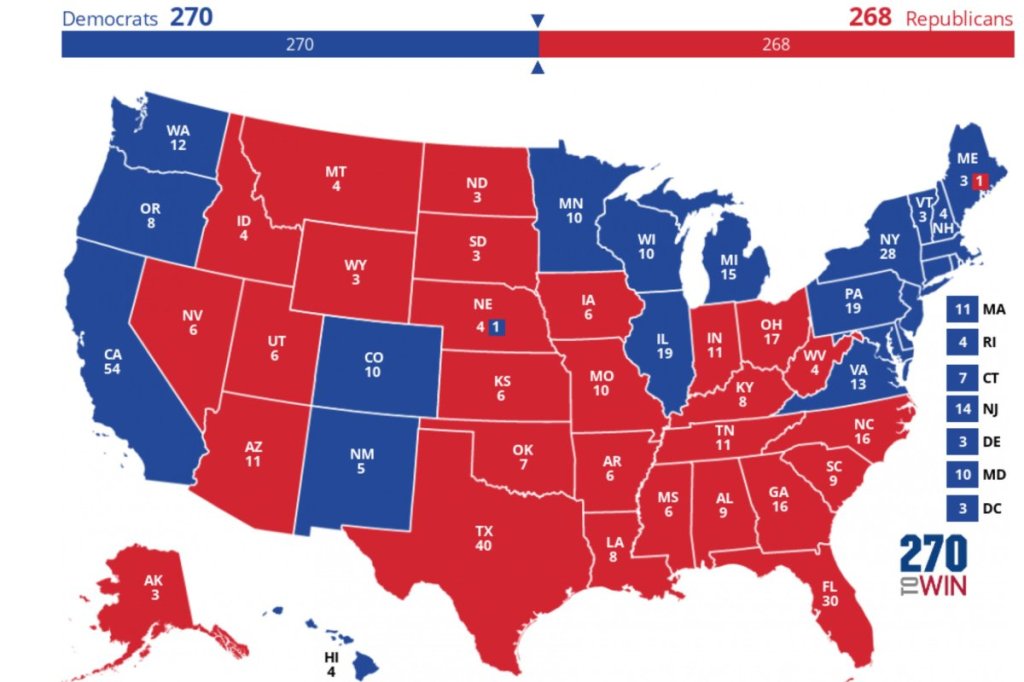
The Electoral College Vote
The Electoral College is the system used to determine the outcome of the U.S. presidential election. Here’s how it works:
- Total Electors: There are 538 electors in the Electoral College, and a candidate needs a majority of 270 electoral votes to win.
- Allocation: Each state gets a certain number of electoral votes based on its population, roughly corresponding to its representation in Congress (Senators + Representatives).
- Winner-Takes-All: In 48 states and Washington, D.C., the candidate who wins the popular vote in that state receives all of its electoral votes. Maine and Nebraska use a proportional system.
Here’s a breakdown of each state’s electoral votes (as of the 2020 Census, which remains current for 2024):
- Alabama – 9
- Alaska – 3
- Arizona – 11
- Arkansas – 6
- California – 54
- Colorado – 10
- Connecticut – 7
- Delaware – 3
- District of Columbia – 3
- Florida – 30
- Georgia – 16
- Hawaii – 4
- Idaho – 4
- Illinois – 19
- Indiana – 11
- Iowa – 6
- Kansas – 6
- Kentucky – 8
- Louisiana – 8
- Maine – 4
- Maryland – 10
- Massachusetts – 11
- Michigan – 15
- Minnesota – 10
- Mississippi – 6
- Missouri – 10
- Montana – 4
- Nebraska – 5
- Nevada – 6
- New Hampshire – 4
- New Jersey – 14
- New Mexico – 5
- New York – 28
- North Carolina – 16
- North Dakota – 3
- Ohio – 17
- Oklahoma – 7
- Oregon – 8
- Pennsylvania – 19
- Rhode Island – 4
- South Carolina – 9
- South Dakota – 3
- Tennessee – 11
- Texas – 40
- Utah – 6
- Vermont – 3
- Virginia – 13
- Washington – 12
- West Virginia – 4
- Wisconsin – 10
- Wyoming – 3
The total number of votes varies with each census, as seats in the House of Representatives are reallocated to reflect population changes.
How It Works:
- Electors by State: Each state has a set number of electors based on its representation in Congress. This means each state has as many electors as it has senators (always 2) and representatives in the House (which varies based on population). For example, California, being populous, has 55 electors, while smaller states like Wyoming have just 3.
- Total Electoral Votes: There are 538 total electoral votes, with a majority of 270 needed to win the presidency.
- State Voting and Winner-Takes-All: In most states, the candidate who wins the popular vote takes all the state’s electoral votes (a system called “winner-takes-all”). Maine and Nebraska, however, use a proportional approach, where they split their electoral votes between candidates based on voting outcomes in different congressional districts.
- Meeting of the Electoral College: After Election Day, electors gather in their states to formally cast their votes for president and vice president. These votes are then sent to Congress for certification.
- Winning the Presidency: The candidate who receives at least 270 of the 538 electoral votes becomes the president.
Key Points:
- Popular vs. Electoral Vote: It’s possible for a candidate to win the popular vote nationwide but lose in the Electoral College. This has happened a few times in U.S. history.
- Focus on Swing States: Candidates often focus on “swing states”—states where the outcome is uncertain—since winning these can be crucial for securing enough electoral votes.
This system was established in the Constitution as a compromise between electing the president by a vote in Congress and by a popular vote of citizens. For the most complete and up-to-date information about the U.S. Election, please visit news sources like The Associated Press and Reuters or check with your state or local election authority.

Primaries and Caucuses: The Road to Candidacy
Before the general election, each political party selects its candidate through a series of primaries and caucuses held in each state. These events allow party members to vote for their preferred candidate, helping narrow down the field to one nominee per party.
- Primaries: Most states hold primary elections, which can be open, closed, or semi-closed. In closed primaries, only registered party members can vote for candidates within their party. Open primaries allow any registered voter to participate, regardless of their party affiliation.
- Caucuses: A few states, like Iowa, still use caucuses, where party members gather at local meetings to discuss and vote on their preferred candidate. Caucuses are more time-intensive and less private than primaries, typically attracting more politically active party members.
The first few primaries and caucuses (like Iowa and New Hampshire) play an outsized role in shaping the race, as solid performances can generate momentum for candidates.
The Role of Campaigns
Political campaigns play a crucial role in elections, as they provide a platform for candidates to communicate their vision, policy proposals, and values. Campaigns have evolved significantly with technological advancements. Social media, for instance, has become a powerful tool for reaching voters, especially younger demographics. While traditional campaign methods like rallies and door-to-door canvassing remain effective, digital campaigns allow candidates to interact directly with voters, often in real-time.
How Often Do Americans Vote?
In the United States, election cycles vary depending on the office. Here’s a breakdown of significant election schedules:
Midterm Elections: Held halfway through a president’s four-year term, these elections allow voters to elect members of Congress (all House seats and about a third of the Senate), as well as many state and local officials.
Presidential Elections: Every four years, voters choose the president and vice president of the United States. These elections, held in November, coincide with several congressional races.
Congressional Elections:
Senate: U.S. Senators serve six-year terms, with approximately one-third of the Senate seats up for election every two years.
House of Representatives: Members of the House serve two-year terms, and every seat in the House is up for election in every even-numbered year, meaning the entire House can change hands within a single election cycle.
State and Local Elections: Many states also hold elections for governors, state legislators, and local officials. The timing of these elections varies by state. Gubernatorial elections are typically held every four years, often coinciding with midterm or presidential election years.
Voter Registration and Voter Turnout
Voter turnout in the U.S. varies widely, influenced by demographics, state regulations, and voter interest. Registration is a prerequisite to voting, though automatic voter registration and same-day registration in some states have helped streamline the process.
Despite various initiatives to encourage voting, America often sees lower turnout compared to other democracies, especially in midterm and local elections. Presidential elections generally attract more voters, with turnout around 60-70% in recent elections. However, disparities remain, with younger voters and minority groups historically underrepresented.
Voting Methods and Accessibility
U.S. voters have several options for casting their ballots, from traditional in-person voting to early voting and mail-in ballots, which gained prominence during the COVID-19 pandemic. States vary in how they handle early and absentee voting, with some requiring an excuse for absentee ballots while others offer no-excuse absentee voting.
To make voting accessible to all, recent years have seen efforts to expand options like vote-by-mail and early voting periods. However, debates over voter I.D. laws and voting restrictions have sparked national conversations on ensuring access without compromising election integrity.
The Challenge of Misinformation
While technology has opened doors for more dynamic and accessible campaigns, it has also introduced the problem of misinformation. During election periods, false or misleading information can spread rapidly, swaying public opinion and undermining trust in the process. Voters must verify information from reliable sources to make informed decisions. Governments and social media platforms are increasingly collaborating to identify and remove misleading content, but it remains a challenge.

Why Voting Matters
Voting is both a right and a responsibility. When citizens vote, they not only decide who leads but also shape the future policies that will govern society. Low voter turnout, however, can lead to leadership that only partially represents the population’s diverse needs and views. While there are many reasons people might not vote—lack of trust in the system, disinterest, or logistical challenges—every vote strengthens democracy.
Steps to Increase Voter Engagement:
Combatting Voter Suppression – Ensuring that everyone has equal access to voting is crucial. Efforts to suppress certain groups of voters erode the democratic process and can lead to an unrepresentative government.
Education and Awareness – Educating people about candidates, policies, and the voting process can make them more likely to vote. Schools, civic groups, and media play an essential role in creating an informed electorate.
Easier Access to Voting – Some countries have introduced measures like early voting, absentee ballots, and online voting to accommodate more people. Making voting easier can significantly increase turnout.
The Global Perspective on Elections
Different countries have different electoral systems. Some use proportional representation, where parties gain seats based on the percentage of votes they receive, while others use a first-past-the-post system, where the candidate with the most votes wins. Both systems have strengths and weaknesses, impacting everything from party dynamics to policy-making.
In countries experiencing political turmoil, elections are particularly critical. Fair and free elections are essential for stability and peace, providing citizens with a nonviolent method to advocate for change. For emerging democracies, holding successful elections can be a step toward political stability, economic growth, and more vital civil institutions.
The Power of the American Vote
At its core, the American electoral system is a representation of democratic values, where every eligible citizen has the right to shape the future of their country. While the system has its imperfections, it has also adapted to changing times and demographics, striving to reflect the voices of a diverse and growing nation.
Whether it’s a presidential election with global implications or a local race impacting community services, each vote represents a part of America’s collective decision-making process. It’s a reminder that in a democracy, the power lies with the people, and every election offers an opportunity to make that power felt.
As American society continues to evolve, so too will its electoral system. Engaging with the process, understanding its nuances, and voting are vital to keeping the democracy robust and representative of the people.
Final Thoughts
Elections empower citizens to influence the direction of their society, underscoring that democracy requires active engagement rather than passive observation. Each vote creates a ripple that touches laws, policies, and even cultural norms. While election seasons can amplify divisions, they also emphasize shared responsibility and governance.
In the United States, elections are a cornerstone of democracy, determining leadership at every level—from local offices to the presidency. Known for their complexity, unique features, and historical depth, American elections have evolved significantly, shaping not only voting practices but also the nation’s future. Here, we’ll explore the basics of the U.S. electoral system, its distinctive elements, and its essential role in guiding the country forward.

 Realizations with Tiffany K. Charles