

You turn on the TV to see what’s on, and it’s nothing but the news. Great. Nothing more than the weather, sports, and political gibberish that you barely understand, but you try your hardest to keep up. You hear the talk about new policies and possible wars erupting and how the Senate and the House of Reps are going at it over a new policy that would benefit some and neglect others. You don’t know all the details, but you make a mental decision based on what is being said. You feel strongly about the matter, and you feel like it will directly affect you. You then start to wonder about the checks and balances of this Government as there is talk about unruly reps seeking to take control of the Country and your freedom……..
The United States government, with its complex structure and unique history, stands as one of the most influential and studied political systems in the world. Established over two centuries ago, it emerged from the ideals of liberty, justice, and democracy that defined a new nation’s identity. From the foundational debates in Philadelphia in 1787 to the landmark decisions and changes that have shaped it since, the story of the U.S. government is one of resilience, innovation, and struggle.
In this blog, we’ll explore the evolution of American governance, the branches that form its backbone, the individuals who have left their mark, and the pivotal events that have challenged and transformed it along the way. Whether you’re new to the subject or a seasoned political history enthusiast, join us as we dive into the fascinating journey of the U.S. government—from its revolutionary roots to its modern-day dynamics.
The Creation of the U.S. Government: Origins and Structure
The U.S. government, formally established after the American colonies declared independence from Great Britain in 1776, has shown remarkable adaptability. It was in the adoption of the U.S. Constitution in 1787 that the framework for the Government was solidified. The Constitution, as the supreme law of the land, outlines the structure, roles, and responsibilities of the Government, demonstrating its ability to evolve and meet the needs of a changing society.
The Founding Fathers, influenced by the political philosophy of Enlightenment thinkers like John Locke and Montesquieu, demonstrated remarkable foresight in their creation of the U.S. government. They believed in the separation of powers to prevent tyranny, which led to the creation of three branches of Government: the Executive, the Legislative, and the Judicial branches.

The Three Branches of Government
- Executive Branch:
Purpose: The Executive Branch is responsible for enforcing the laws of the Country. It is headed by the President, who serves as the Commander-in-Chief of the military, negotiates treaties, and can issue executive orders.
Creation: The Executive Branch was established under Article II of the U.S. Constitution. It was designed to provide leadership, execute laws passed by Congress, and manage the day-to-day operations of the Federal Government.
Checks on Power: The Executive Branch is checked by the Legislative Branch through its ability to override presidential vetoes and by the Judicial Branch through judicial review. Congress can also impeach the President.
2. Legislative Branch:
Purpose: The Legislative Branch is responsible for making laws. It consists of two bodies: the Senate and the House of Representatives, collectively known as Congress.
Creation: Article I of the Constitution establishes Congress, reflecting the Founding Fathers’ desire for a bicameral (two-house) system of representation.
Checks on Power: The Legislative Branch can check the Executive by overriding vetoes, approving or rejecting appointments, and through its power of impeachment. It checks the Judiciary by determining the structure of the federal courts and approving appointments of judges.
3. Judicial Branch:
Purpose: The Judicial Branch interprets laws and ensures they are in line with the Constitution. The U.S. Supreme Court is the highest in the land, with other federal courts supporting the judicial system.
Creation: Article III of the Constitution establishes the Supreme Court and allows for the creation of lower federal courts. Judges are appointed for life, serving to maintain impartiality and independence.
Checks on Power: The Judicial Branch has the power of judicial review, which allows it to invalidate laws or executive actions that violate the Constitution. The Legislative Branch checks it through its ability to amend the Constitution, and by the Executive Branch through judicial appointments.

The System of Checks and Balances
The U.S. government operates under a system of checks and balances, where each branch has specific powers that limit the authority of the others. This was designed to prevent any single branch from becoming too powerful. For instance:
- The President can veto legislation, but Congress can override the veto with a two-thirds majority.
- Congress can pass laws, but the Supreme Court can strike down laws it deems unconstitutional.
- The President appoints federal judges, but the Senate must approve these appointments.
This balancing act ensures that governance is shared, preventing the consolidation of power.
The U.S. Senate and House of Representatives: Structure and Function
Congress is divided into two chambers, each with distinct responsibilities and structures:
- The Senate:
- Number of Members: 100 Senators (two per state).
- Term Length: Senators serve six-year terms, with elections staggered so that about one-third of the Senate is up for election every two years.
- Role: The Senate has the power to confirm presidential appointments, ratify treaties, and conduct impeachment trials. Senators represent their entire states, making them less susceptible to rapid political shifts.
- The House of Representatives:
- Number of Members: 435 Representatives (based on state population).
- Term Length: Representatives serve two-year terms, making the House more responsive to shifts in public opinion.
- Role: The House has the power to initiate revenue bills and impeach federal officials. Representatives serve specific districts within their states, offering a more localized form of representation.
Together, the Senate and the House must work to pass federal laws. This bicameral structure was a compromise between smaller states, which wanted equal representation (hence the Senate), and larger states, which wanted representation based on population (hence the House).

The Evolution of Political Parties in the U.S.
Political parties have played a significant role in shaping U.S. elections and policy debates. The U.S. needed to start with a transparent two-party system. In fact, political factions began to form during the early years of the republic, primarily driven by disagreements over federalism.
- The First Party System (1790s–1820s): The first significant parties were the Federalists, who advocated for a strong central government, and the Democratic-Republicans, who favored states’ rights and a more decentralized government. Figures like Alexander Hamilton led the Federalists, while Thomas Jefferson and James Madison championed the Democratic-Republicans.
- The Second Party System (1820s–1850s): As the Federalists dissolved, the Democratic-Republicans split. This era saw the rise of the Democratic Party under Andrew Jackson, which favored expansion and populism, and the Whig Party, which supported modernization and economic protectionism.
- The Third Party System (1850s–1890s): In the mid-19th century, the Republican Party emerged, formed primarily by anti-slavery activists and former Whigs. Abraham Lincoln’s election as the first Republican President in 1860 marked the beginning of the party’s dominance during the Civil War and Reconstruction eras.
- The Modern Two-Party System: By the late 19th century, the U.S. political landscape solidified into a two-party system, with the Democratic Party and Republican Party as the dominant forces. The Democrats generally advocated for social programs, labor rights, and civil liberties, while the Republicans often focused on free-market policies, national security, and conservative social values. Although third parties have emerged throughout U.S. history, such as the Green Party and Libertarian Party, the two-party system has remained firmly entrenched in the presidential elections due to electoral processes like the Electoral College.
Election and Term Lengths
The President: Elected for a four-year term, with a limit of two terms (maximum of eight years). Senators: Serve six-year terms, with staggered elections every two years to ensure continuity. Representatives: Serve two-year terms, making them more responsive to changes in public opinion. Supreme Court Justices and Federal Judges: Appointed for life, ensuring judicial independence from political pressure.
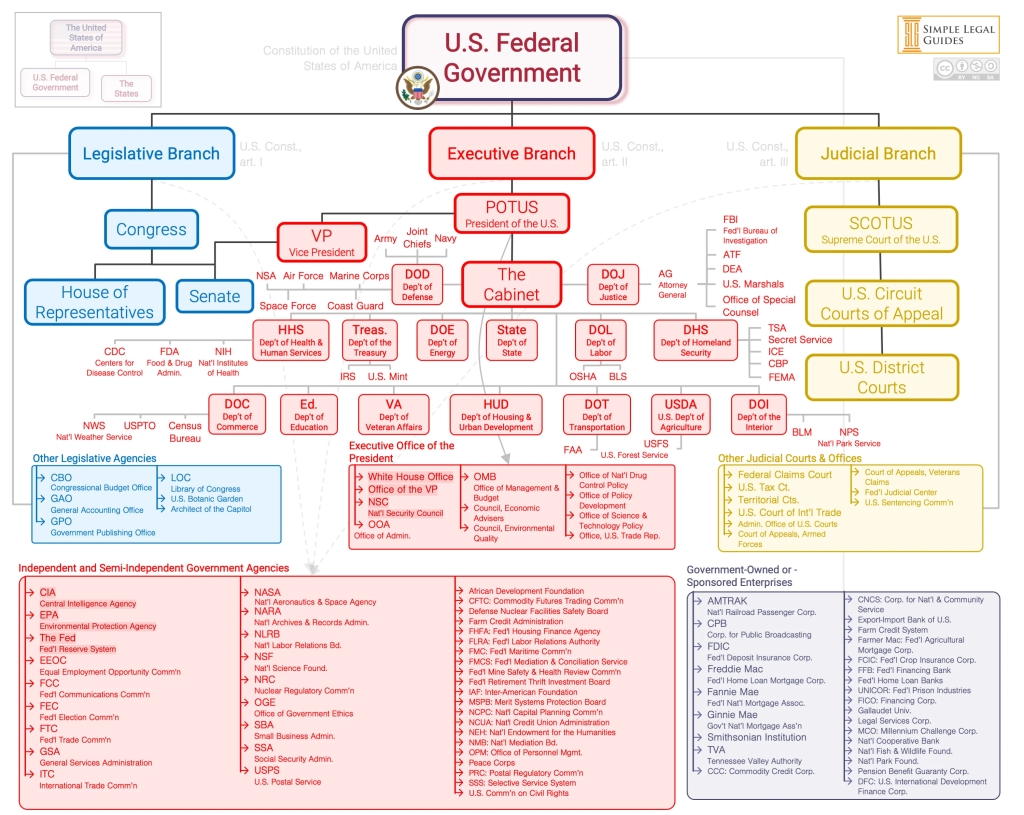
The Changing Landscape of the U.S. Government: Navigating the Future
The United States government has long been a symbol of democracy, flexibility, and adaptability. Over the centuries, it has transformed through various political, social, and technological changes, reflecting the evolving nature of American society. Today, the U.S. government faces unprecedented challenges and opportunities, and its future is poised for significant changes driven by technology, shifting political dynamics, and societal demands.
Technology’s Growing Influence
One of the most dramatic shifts in governance is the increasing role of technology. The Federal Government is investing heavily in digitization, artificial intelligence (AI), and cybersecurity. Agencies like the Department of Defense (DoD) and NASA have long embraced technological innovations. Still, now civilian services like the IRS, healthcare systems, and public safety are undergoing tech-driven transformations as well.
AI is expected to streamline governmental operations, from automating routine tasks to providing more efficient services to citizens. For example, the U.S. Digital Service (USDS) and similar initiatives are working to modernize government websites, making them more accessible, secure, and user-friendly. As citizens increasingly demand faster and more transparent services, the Government is adapting with digital tools that offer real-time updates on everything from taxes to disaster relief.
Moreover, the rise of data analytics is expected to change how policies are shaped. Data-driven decisions will allow legislators to understand societal needs and target resources better and more effectively. However, this also raises concerns about privacy and surveillance, challenging the Government to find a balance between innovation and civil liberties.
Political Polarization and Reform
Political polarization in the U.S. has deepened over the past few decades, shaping both the discourse and functionality of Government. Despite this, there is a growing recognition that structural reforms may be necessary to ensure the Government remains effective. One proposed change is electoral reform. Systems like ranked-choice voting, which allows voters to rank candidates in order of preference, are gaining traction in some states. This system can help reduce the divisiveness of elections and encourage politicians to build broader coalitions rather than catering to extreme bases. Maine and Alaska have already implemented ranked-choice voting, and more states may follow suit as political gridlock frustrates voters.
Similarly, there is growing interest in reforming the U.S. Senate and the Supreme Court. The debate around term limits for justices and expanding the number of seats in the court has intensified in recent years, reflecting concerns about the balance of power and long-term accountability in the Judiciary. Meanwhile, discussions around the filibuster, a Senate rule requiring a supermajority for many legislative decisions, highlight the ongoing debate about how the U.S. government should handle legislative gridlock.

The Rise of Youth and Diverse Voices
As new generations come of age, the composition of the U.S. electorate is shifting, bringing fresh perspectives to governance. Millennials and Gen Z now make up a significant portion of the voting public, and their priorities often differ from older generations. Issues such as climate change, student debt relief, healthcare reform, and social justice dominate their agendas, pushing these topics to the forefront of national debate.
Furthermore, the Government itself is becoming more diverse. The 2024 election cycle is likely to see a record number of women, people of color, and LGBTQ+ candidates running for office at every level. This diversity is slowly reshaping the U.S. political landscape, making it more representative of the nation’s population. The increasing diversity of elected officials helps ensure that a broader range of perspectives and lived experiences are brought to the table when crafting legislation.
Climate Change and Sustainability Initiatives
Climate change is no longer a distant threat but a present reality that the U.S. government must address. In recent years, there has been a push toward enacting more sustainable policies and investing in clean energy. President Biden’s administration, for example, set ambitious targets for reducing carbon emissions, promoting electric vehicles, and investing in renewable energy through the Inflation Reduction Act and the Bipartisan Infrastructure Law.
Future governments will likely continue to focus on these areas, driven by both domestic needs and international pressure. The role of the federal Government will be crucial in coordinating state and local efforts to mitigate the impact of climate change, from addressing the frequency of natural disasters to ensuring water and food security.
Globalization and Foreign Policy in Flux
As the world becomes more interconnected, the U.S. government is also evolving in how it approaches global relations. While the U.S. continues to be a key player on the world stage, the geopolitical landscape is shifting. The rise of China as a global power, the war in Ukraine, and challenges like global pandemics are reshaping U.S. foreign policy.
The future U.S. government will need to balance domestic priorities with international leadership. Cybersecurity, trade, and alliances are critical areas of focus, particularly as globalization blurs the lines between domestic and international concerns. As seen with issues like supply chain disruptions and the spread of COVID-19, events across the world can quickly impact American citizens, making foreign policy more relevant than ever.

Final Thoughts
The U.S. government stands as a complex, meticulously structured system that has grown and adapted over more than two centuries. At its core, three distinct branches work together, each equipped with powers that keep the others in check. This dynamic balance prevents any single branch from overpowering the others, upholding the democratic principles upon which the nation was founded. Political parties, notably the Democratic and Republican parties, further shape governance and policy, with each bringing unique perspectives to the table, especially in presidential elections.
This system of checks and balances underscores the resilience of American democracy, demonstrating how the Government evolves while remaining anchored to its foundational ideals. This adaptability is essential in meeting the changing needs of its people.
Far from static, the U.S. government is continuously evolving. It responds to the needs of its citizens, adapts to modern challenges, and integrates innovations that transform societal functioning. As technology advances, political landscapes shift, and social dynamics progress, the Government must be ready to adapt to these changes. Looking ahead, it is likely that the U.S. government will become increasingly digital, diverse, and open to reform—mirroring the evolving American society it serves. While the future may bring uncertainty, the Government’s adaptability will be crucial in meeting the challenges of the decades to come.
 Realizations with Tiffany K. Charles